-
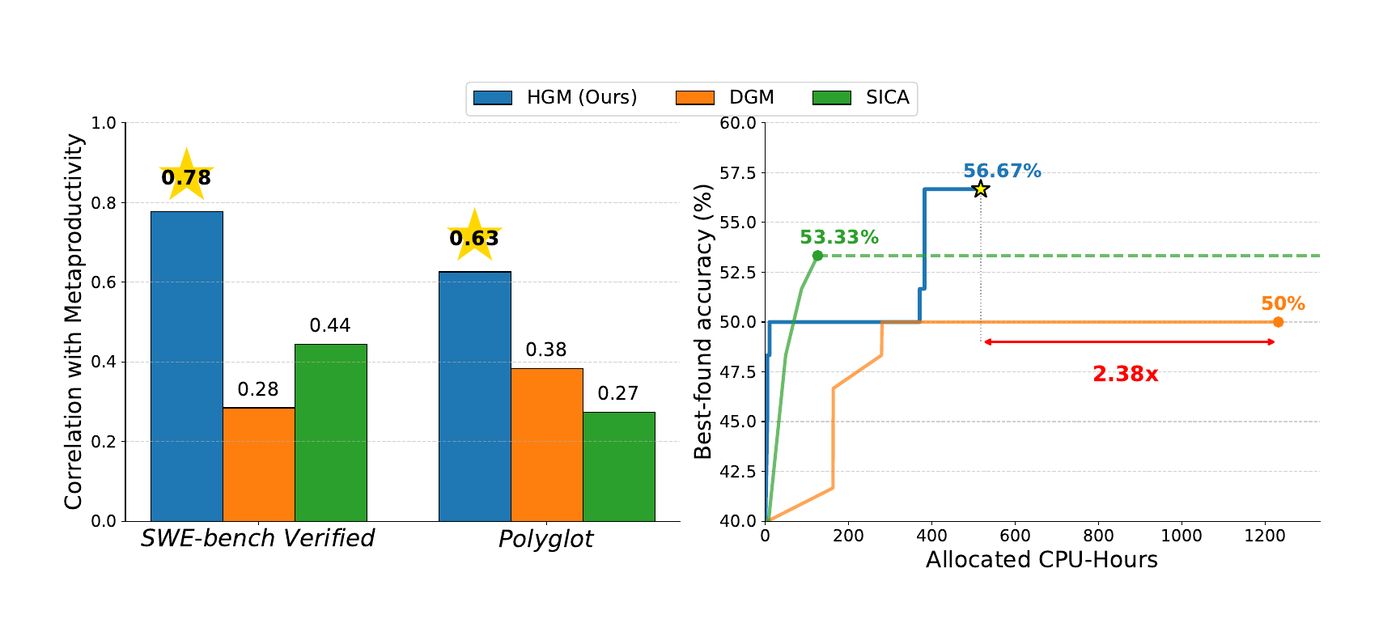
Reading Notes of Huxley-Gödel Machine: Human-Level Coding Agent Development by an Approximation of the Optimal Self-Improving Machine
TL;DR: A "better" scorer for evaluating coding agents.
-
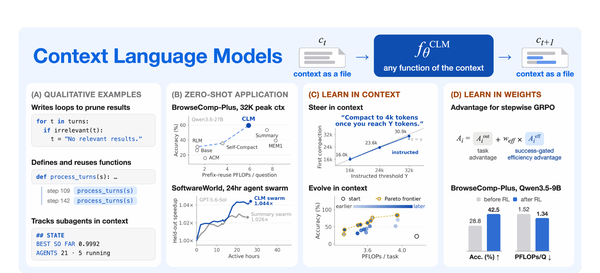
Reading Notes of Context Language Models
TL;DR: The LLM can freely treat its context as a file to edit it with code, so the model decides what to keep, compress, or delete.
-
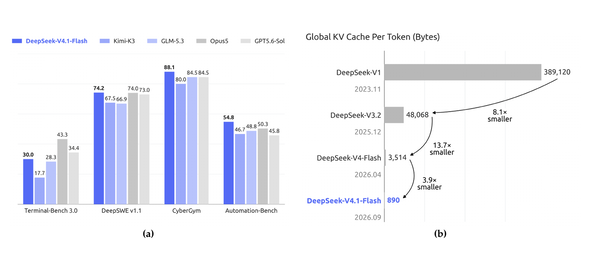
Reading Notes of DeepSeek-V4.1-Flash: Pushing the Limits of KV Cache Compression
TL;DR: Upper layers reuse memory built by its lower layers, groups of layers share one 4-bit memory, and short-lived local memory is rebuilt instead of stored.
-
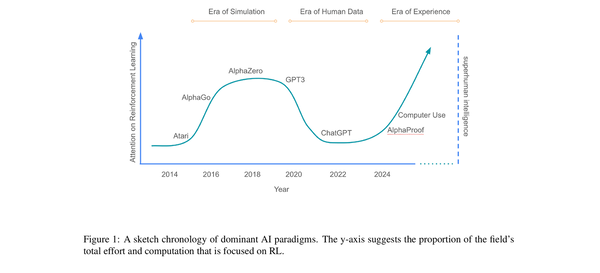
Reading Notes of Welcome to the Era of Experience
TL;DR: Introducing experiential learning
-
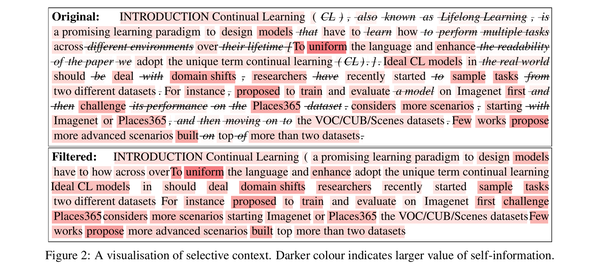
Reading Notes of Selective Context: Compressing Context to Enhance Inference Efficiency of Large Language Models
TL;DR: using perplexity on a small LLM as the heuristic. The assumption is that context tokens with lower surprisal can be deleted. Not really optimize the policy model to minimize the cost.
-
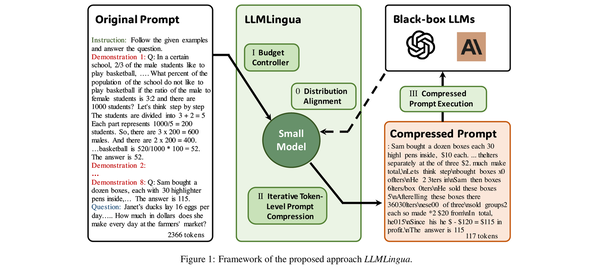
Reading Notes of LLMLingua: Compressing Prompts for Accelerated Inference of Large Language Models
TL;DR: using perplexity on a small LLM as the heuristic. The assumption is that context tokens with lower surprisal can be deleted. Not really optimize the policy model to minimize the cost. The difference to Selective Context is that it (a) scores every unit independently, so it doesn't know what has already been deleted, and (b) ignores the mismatch between the small scoring LM and the target LLM.
-
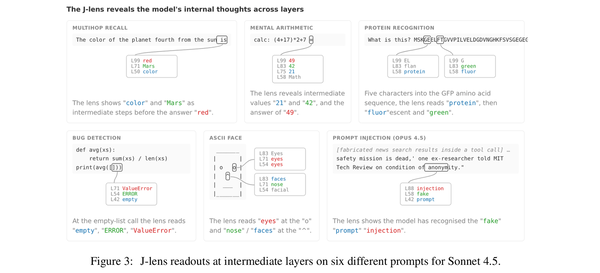
Reading Notes of JLens: Verbalizable Representations Form a Global Workspace in Language Models
TL;DR: An interpretability method that unembeds middle hidden states transformed with a Jacobian matrix. I don't know why it works in math.
-
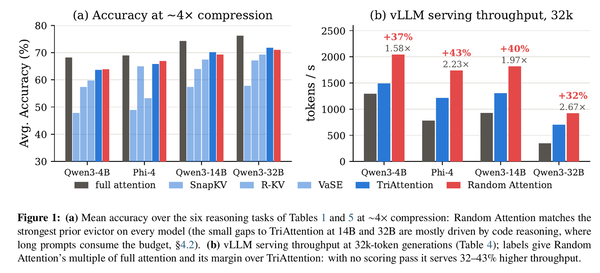
Reading Notes of Random Attention: Rethinking KV Cache Eviction for Efficient Reasoning
TL;DR: random KV eviction works better than heuristics ones.
-
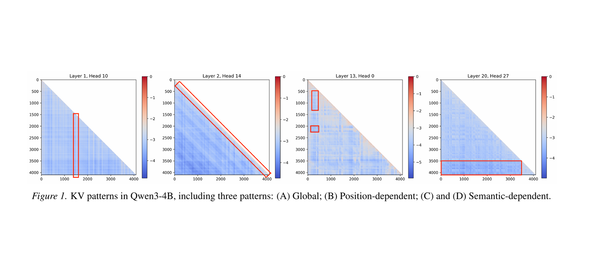
Reading Notes of ForesightKV: Optimizing KV Cache Eviction for Reasoning Models by Learning Long-Term Contribution
Something similar with the KVP (and arxived at similar time). Use SFT to train on "oracle" tokens related to future attention. Use RL/GRPO to penalize loss spikes on low-entropy (tokens that should be easy to predict) tokens.
-
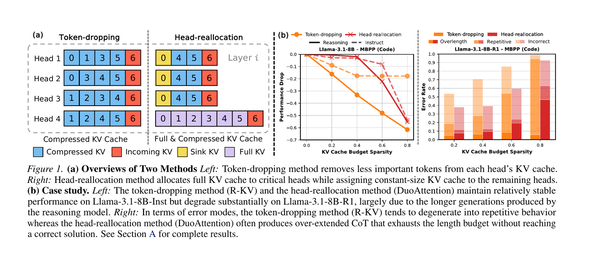
Reading Notes of RLKV: Which Heads Matter for Reasoning? RL-Guided KV Cache Compression
TL;DR: Some of heads should not do KV cache eviction. This paper predicts which heads to do KV cache eviction and which heads to do full KV cache. MDP process trained with RL/GRPO based on task success - non-sparsity of KV cache eviction heads (more task success with more heads to do KV cache eviction.)